Two People, One Room, Zero Screens: Why Side-by-Side Silence Is the Toughest Date You'll Ever Plan
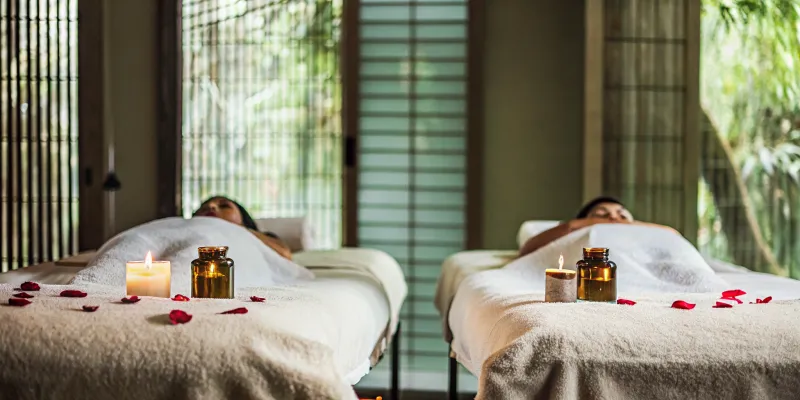
Photo: couples massage side by side spa room candles dim lighting, via www.nolablissmassage.com
Here's an uncomfortable truth we've noticed after years of watching couples come through our doors: most partners have never truly been quiet together. Not on the couch with Netflix humming in the background. Not at dinner with phones face-down but very much within reach. I mean actually still, actually silent, actually present with nothing to do but exist next to each other.
It sounds dramatic until you try it. Then it makes perfect sense why the couple's massage — two people, one dim room, no screens, no small talk required — feels like such a strange and surprisingly vulnerable experience the first time.
We've Engineered Silence Out of Our Relationships
Think about how American couples spend time together. We meet for drinks. We binge a show. We take a road trip with a playlist doing the emotional heavy lifting. Nearly every shared activity comes with a built-in distraction — something to watch, react to, or comment on so nobody has to just be with anybody.
Researchers who study couple behavior have found that shared novel experiences bond partners, but there's a quieter finding buried in that literature: shared presence matters too. It's not the activity that does the work. It's the feeling of being seen and accompanied while your guard is down.
Screens make that nearly impossible. Even a phone sitting silent on a nightstand changes the texture of a room. We've all felt it — that low hum of possible interruption that keeps half your brain on standby.
Why Doing Nothing Together Feels So Exposed
The first few minutes of a couples massage are, honestly, a little awkward for most people. There's the rustling of sheets, the uncertainty of where to put your arms, the sudden awareness that another human can hear you breathe.
And then something shifts. Usually around minute ten or fifteen, the room settles. Breathing syncs — sometimes literally. The nervous system, which has spent all day scanning for emails and traffic and notifications, finally gets permission to stand down.
What makes this powerful for couples isn't romance-movie magic. It's simpler than that: you're witnessing each other in a state you almost never share. Relaxed. Unguarded. Not performing, not problem-solving, not scrolling. For many partners, it's the first time in months they've been in the same room with no agenda at all.
Some couples tell us afterward that they didn't say a word for an hour and it was the best conversation they'd had in weeks. We believe them.
Planning Your First Couples Session: A Mini-Guide
If you're thinking about booking one, a little preparation turns nervousness into anticipation.
Talk about the silence beforehand. Agree that you don't need to chat. Take the pressure off the moment before you're in it. Some couples even set a rule: no talking unless one of us needs something.
Pick your pressure honestly. One of you might want deep tissue while the other wants something gentle. That's fine — you don't have to match. Mention preferences when you book so nothing needs negotiating in the room.
Arrive early, not rushed. A couples session that starts with a parking-lot argument about directions defeats the purpose. Build in fifteen extra minutes for tea, a restroom stop, and a deep breath.
Decide what happens after. The best part of a shared massage is often the hour that follows — a slow lunch, a walk, a drive home with the radio off. Plan something low-key so the calm has somewhere to land.
Skip the big occasion pressure. Anniversaries are lovely, but a random Tuesday in February often makes for a more genuine reset than a high-stakes Valentine's Day slot.
Not Ready to Book? Try the At-Home Version
Shared stillness is a skill, and like any skill, you can practice it cheaply before committing to the real thing.
- The ten-minute floor sit. Lights low, phones in another room, sit next to each other and do absolutely nothing. It will feel bizarre for the first three minutes. Push through.
- Trade a five-minute shoulder rub. No technique required. The point isn't the massage — it's the undistracted touch and attention.
- The screen-free walk. Same neighborhood, same route, no earbuds. Silence counts as conversation.
- The breath sync. Sit facing each other and try to breathe at the same pace for two minutes. Yes, it sounds like a yoga class exercise. It works anyway.
If those feel good rather than excruciating, you're ready for the full version. If they feel excruciating — well, that's useful information too, and honestly, it means you need it more than most.
The Hardest Thing You'll Do All Year, and the Easiest to Schedule
We plan elaborate vacations to feel connected and then spend them photographing the view. Meanwhile, the thing that actually rebuilds closeness — sitting quietly next to another person with nothing to distract either of you — costs an hour and takes zero packing.
Namaste, after all, is a greeting that honors the light in the other person. It's hard to honor anything in someone you're only half-looking at. An hour of shared stillness, whether on a massage table or a living room floor, might be the most honest way to say it without saying anything at all.